

 Slovenská verzia
Peach
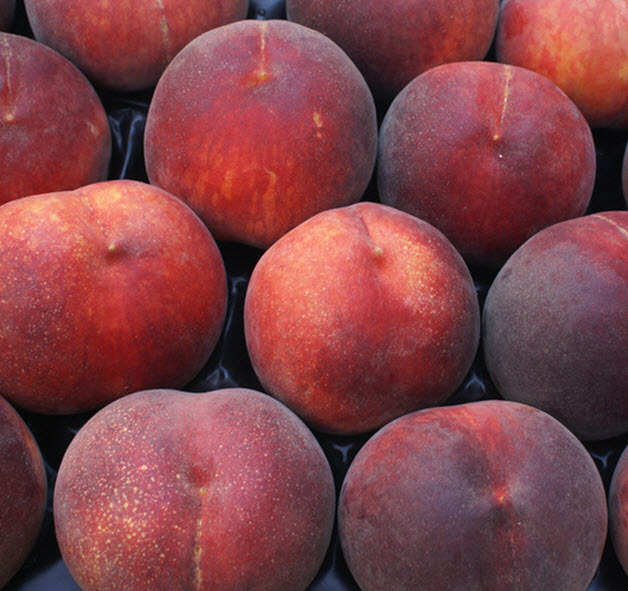
Peaches, like apricots, are among the most attractive fruits in the summer season, and with the right varietal composition, it is possible to harvest fruits practically throughout the summer.
Short description of the species
Interesting
Peaches are a low-calorie fruit containing vitamin A and beta carotene, which contributes to reducing the risk of lung, esophagus and larynx cancer. In addition, they contain many valuable minerals, such as potassium and iron.Usage
direct consumption, nectar processing, distillation, jamsSuitable growing locations
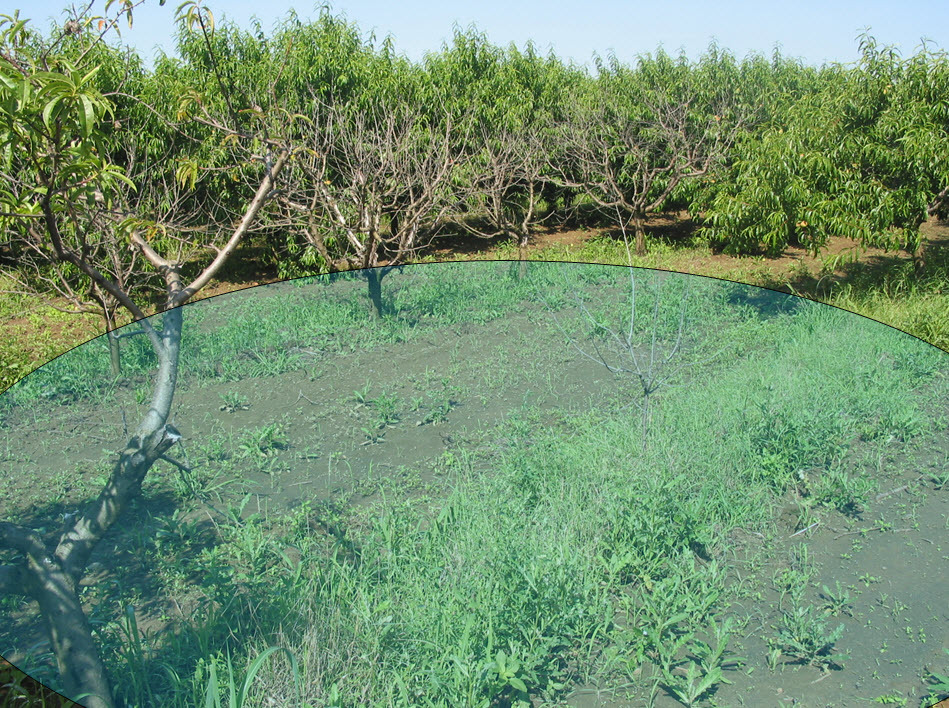
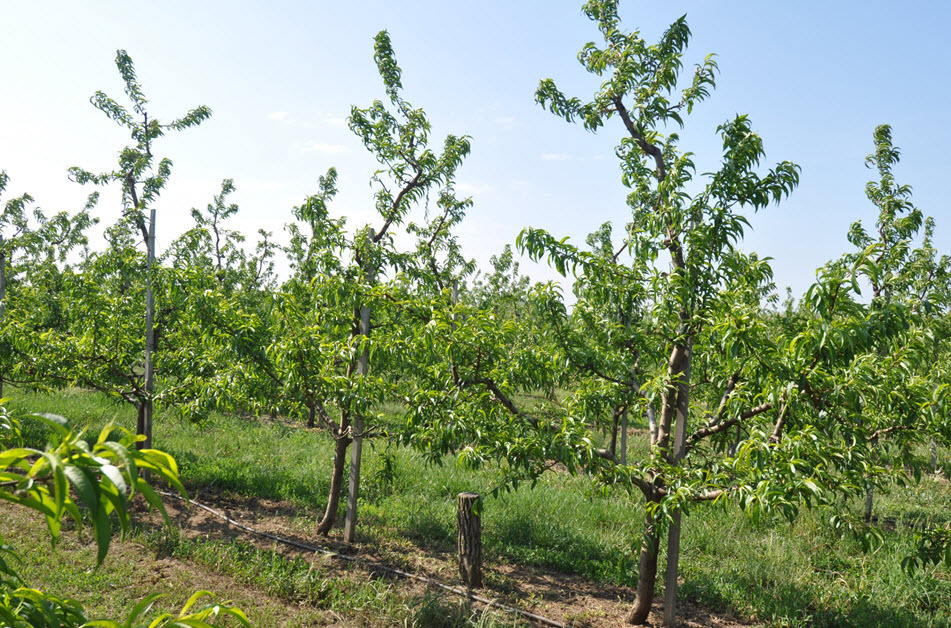
Similarly, like apricots, peaches can be grown successfully only in the warmest locations with an average annual temperature of 9°C, an altitude of up to 200m and an average annual rainfall of up to 600m. Rather, they require lighter sandy soils with a low water table because they are very demanding on the air content in the soil. If the soils are heavier and waterlogged, the roots will begin to die and asphyxiation will occur. They are also sensitive to a higher content of subsurface water, and in the case of a longer-lasting condition, asphyxiation also occurs. As a prevention, we recommend to level the soil perfectly on clayey soils and flat terrain so that there are no soil depressions in the form of deeper pits. They prefer hills and gentle slopes. From this point of view, the relation to late spring frosts, to which peaches, like apricots, are very sensitive, is also very important. We therefore avoid basins and partly also plains, where the cold air has nowhere to flow.
Suitable rootstocks
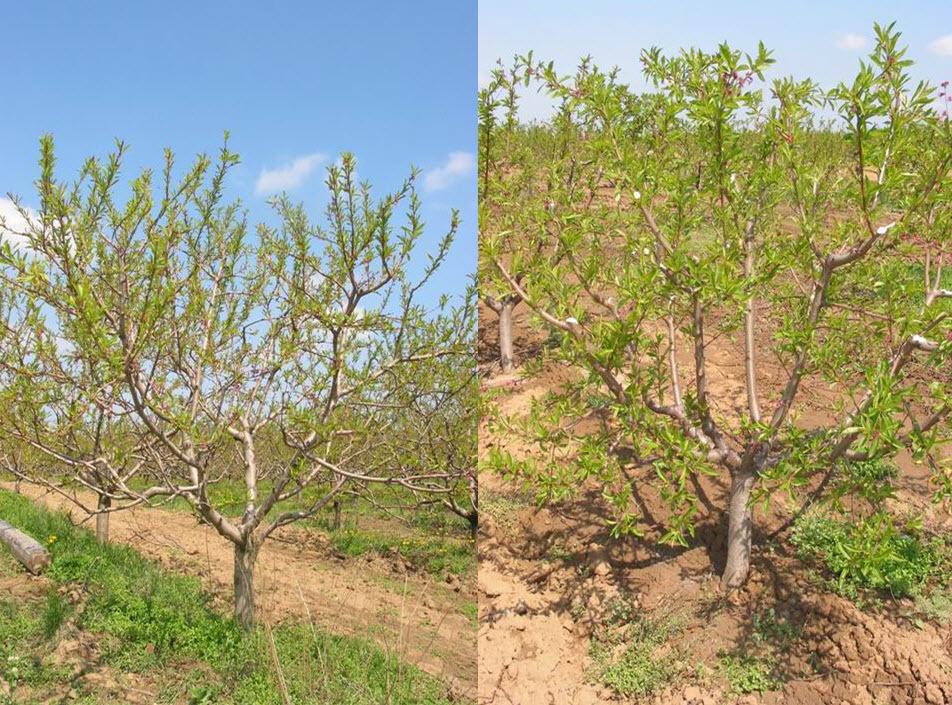
For peaches, the most important criterion for choosing a rootstock is its tolerance to the CaCO3 content in the soil, and based on that, choose the rootstock. In general, for soils with a CaCO3 content of up to 5%, peaches can be used, peach almonds up to 10% and almond rootstocks above 10%. A very suitable rootstock is GF-655/2, which weakens growth compared to peach seedlings by 20-30%. It has a shallow root system and is also suitable for heavier soils and is thus more resistant to asphyxiation. It tolerates 8-10% CaCO3 and shows good affinity with nectarines. The Rubira rootstock is also suitable for growing peaches in the shape of a slender spindle. It is essentially a red-leaved peach seedling that can also be used as an ornamental tree or shrub. It has a good affinity with the varieties, the growth is moderately strong, so we recommend it either for light, sandy soils as a classic spindle up to a height of 2.3-2.5m, or for better and more nutritious soils, where it can grow to a height of more than 3m. Despite the fact that it is propagated generatively, the rootstocks achieve excellent homogeneity. It is more resistant to aphids. The fruits of the varieties grafted on this rootstock achieve selection quality. The Montclar rootstock is also very suitable for the slender spindle shape. They have a good affinity with the varieties and the growth is slightly stronger than on the Rubira rootstock, so it is optimal for light and permeable sandy soils and is also suitable for poorer and stony soils, but they do not tolerate waterlogged soils. Tolerance to CaCO3 content is up to 7%. It is also sensitive to frost damage in the area of the root neck and can form undergrowth. It is sensitive to viruses, but the quality of the fruits is selective.
Suitable varieties
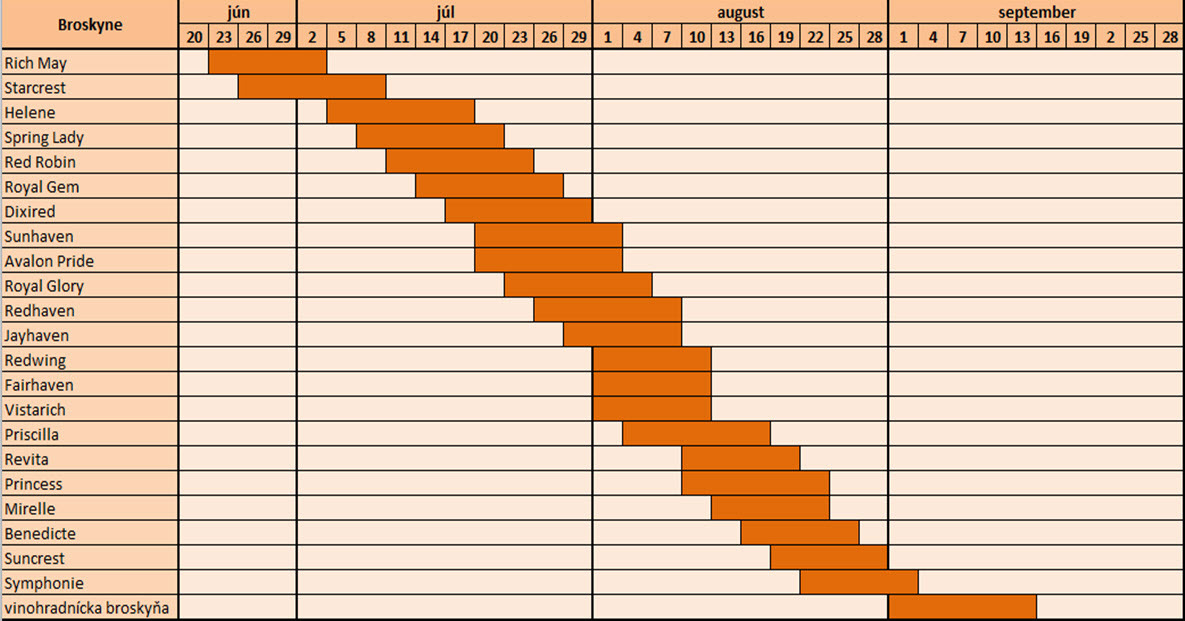
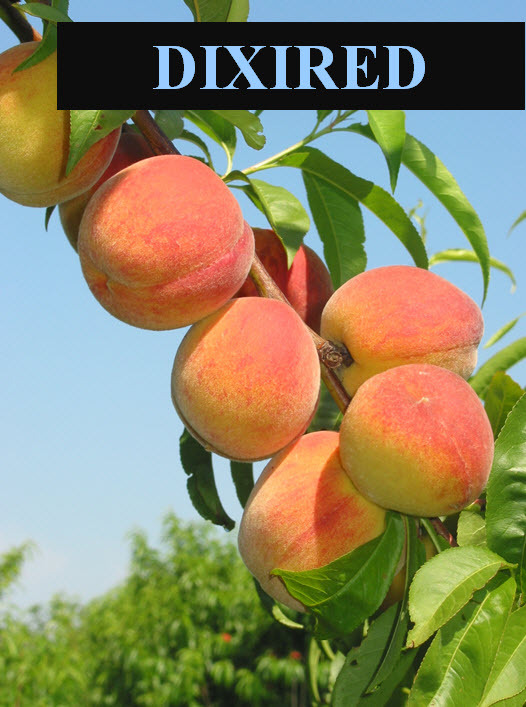
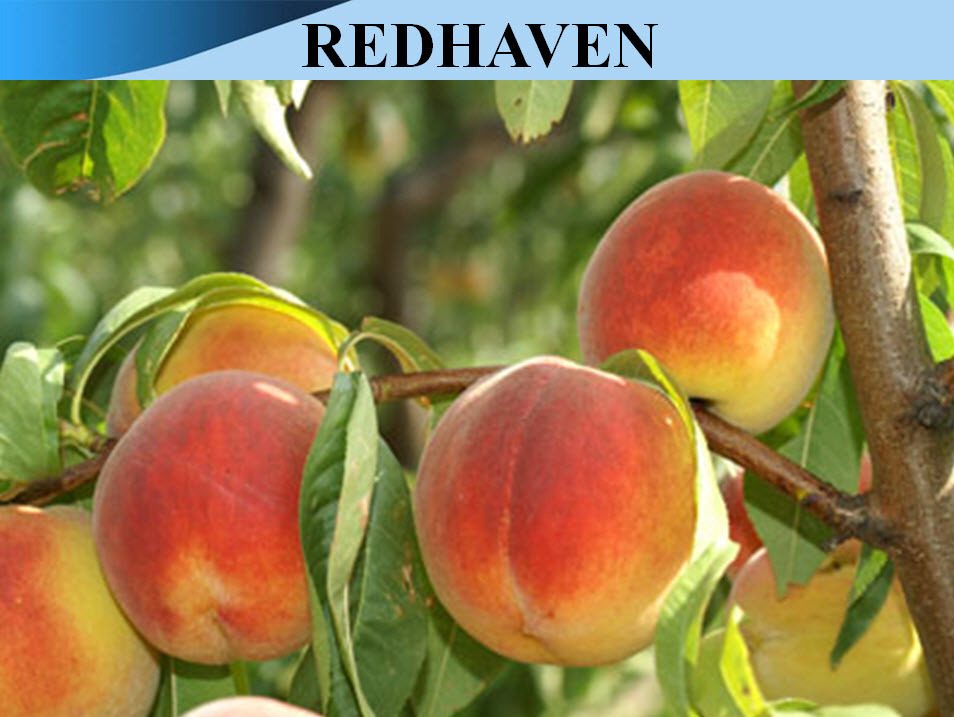
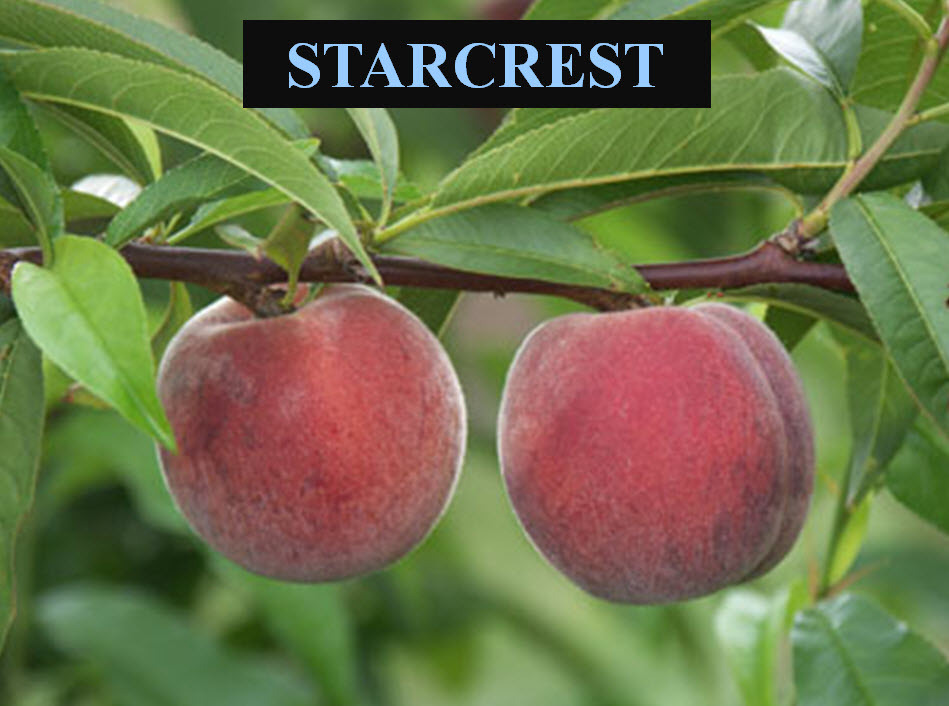
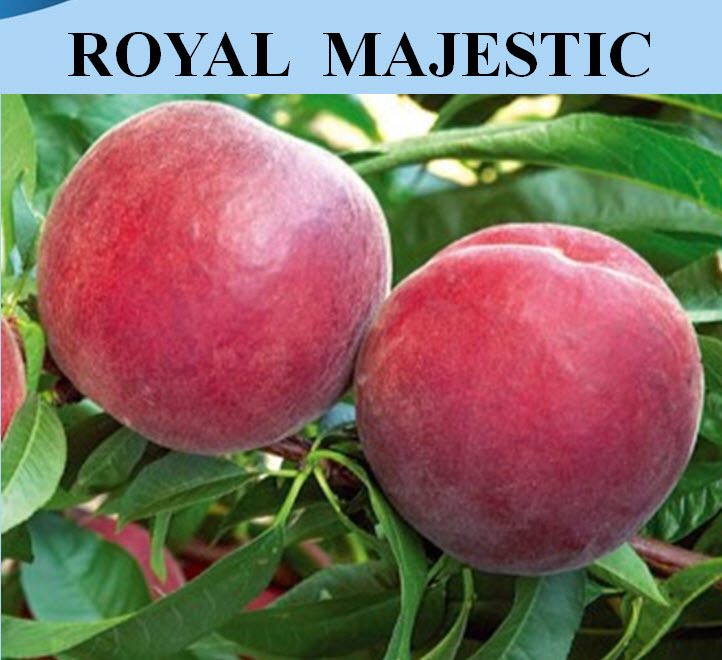
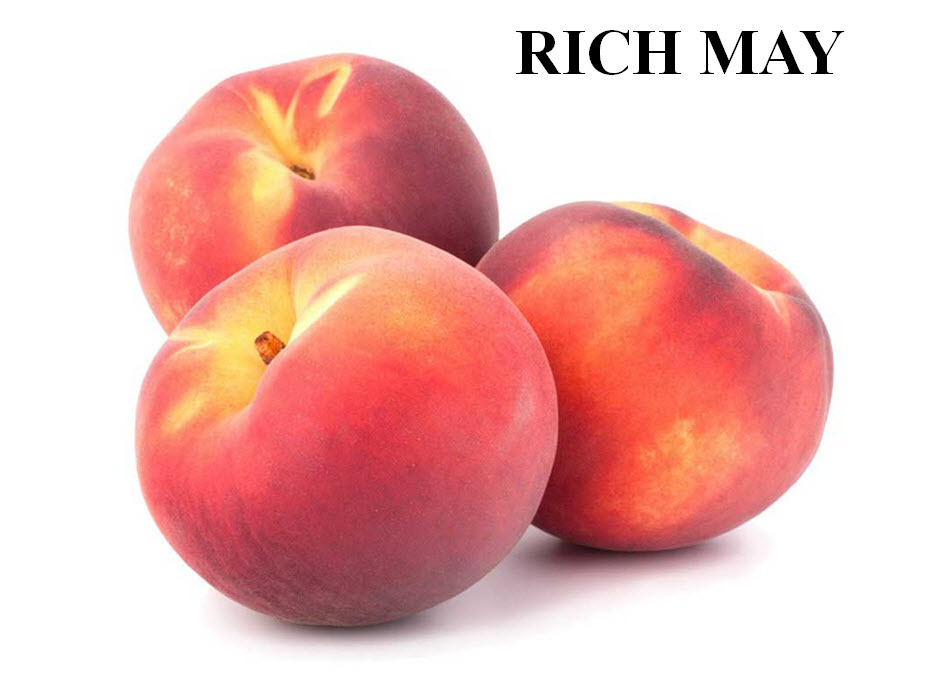
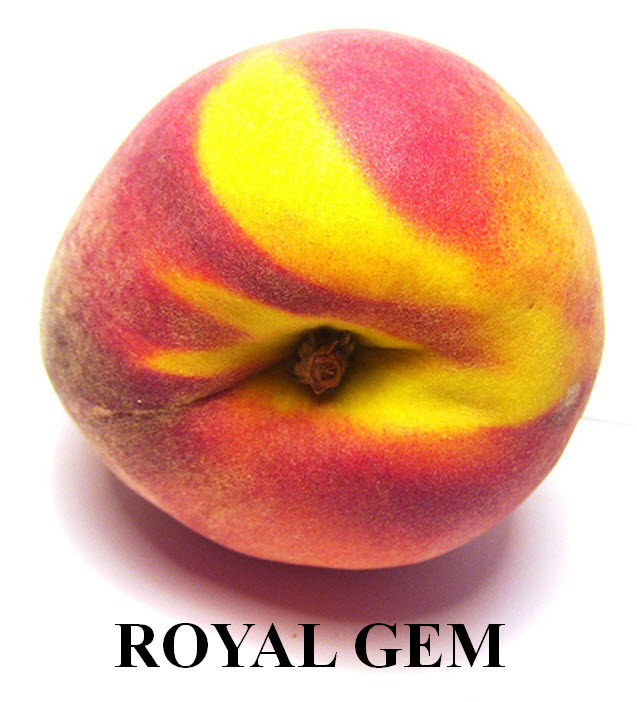
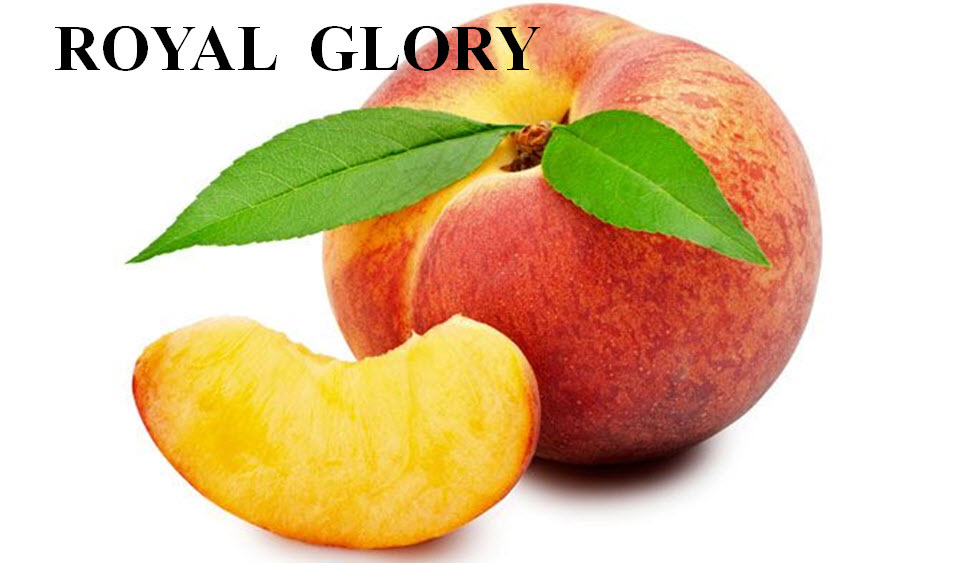
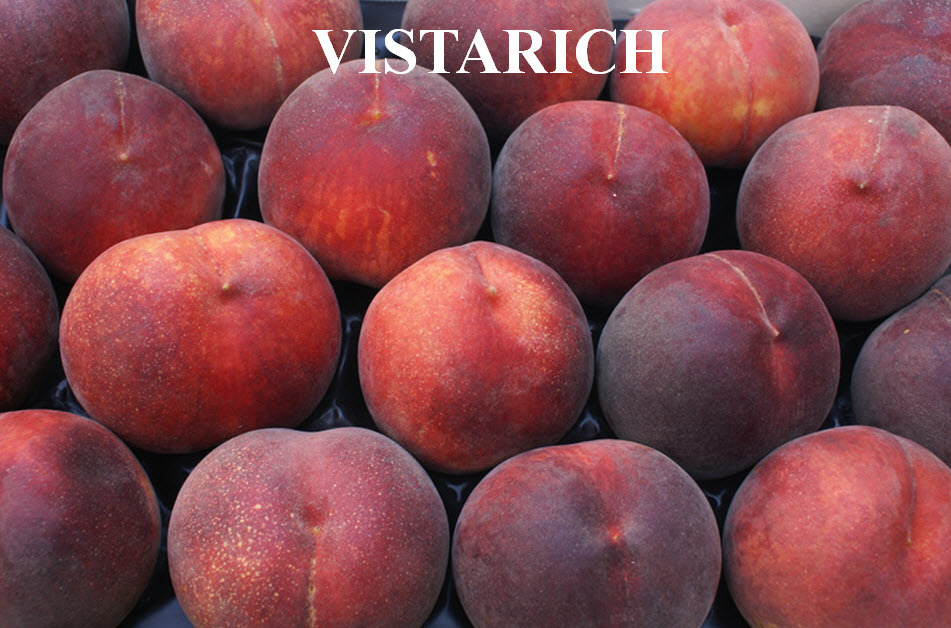
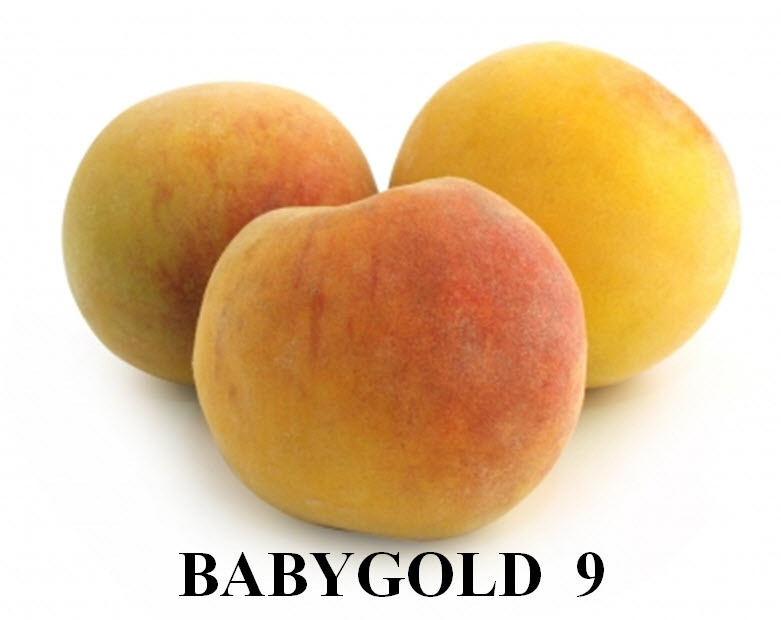
Of the early varieties ripening already at the beginning of July, or during the month of July there are varieties Starcrest, Primerose, Royal Gold, Alexandra. Of the varieties ripening at the end of July - beginning of August, Spring Lady and Royal Gem are suitable. Varieties ripening in August with attractive fruits are e.g. Dixired and Royal Glory. Similar to how the Hungarian variety is the standard for apricots, the medium-early ripening Redhaven variety is the standard for peaches. From the classic varieties, it is also possible to grow the Fairhaven or Halehaven varieties. Among the varieties ripening at the end of August are e.g. Queen Lady, Pscientifica and Daisy. Varieties maturing at the beginning of September are e.g. Benedict, Cresthaven, or Symphonie. Varieties such as Sensation, Royal Prince and Calred ripen at the end of September. And for peaches, extremely late-ripening varieties are, for example, Babygold 9, Laura and Gladys. From nectarines, e.g. Early Devil, Snowqueen, Harblaze, Stark Redgold and Sandwich Nectarine Flateryna and others, although due to their stronger growth, they are not suitable for all types and types of soil and moderately strong growing rootstocks.
Diseases and pests
diseases: peach leave curl, brown rot, spots and holes in leaves
pests: peach fruit rot, peach pest, aphids
Labeling Plants with QR Codes
At the Faculty of Horticulture and Landscape Engineering at SPU in Nitra, we've created a project that offers visitors to our plantings a new way to discover the beauty and intriguing aspects of plants. Each plant in our plantings has its own unique QR code. All a visitor needs to do is scan this code with their smartphone.
Encyclopedy
Informácie
Kontakt
Fakulta záhradníctva a krajinného inžinierstva
Tulipánová 7, 949 76 Nitra
phone +421 (37) 641 4229 — study department
email henrieta.budayová@uniag.sk



Copyright © 2026 Faculty of Horticulture and Landscape Engineering